My father, caught completely off guard, could only stare down at the floor. It was not until Dr. Kafka had taken his seat at the desk that my father managed to find his words again: “My dear Doctor, you are a rebel.”
“Regrettably,” Kafka replied, “the rebellion I am engaged in is the most exhausting, and perhaps the most hopeless, of all.”
“A resistance against whom?”
“Against myself.” Kafka partially closed his eyes, leaning back into his armchair. “Against my own limitations and inertia. Ultimately, it is a resistance against this very desk and this very chair.”
In my high school literature textbook, there were two lessons that left an indelible impression on me. One was Lu Xun’s Medicine—memorable because we actually performed it as a stage play in class, and I played the old father who bought the bun soaked in human blood. The other was Kafka’s Before the Law. Yet, my impression of the latter was not born of any profound understanding, but rather of its utter abstraction and incomprehensibility. After all, to a high schooler, anything abstract and mysterious equates to being sophisticated. It was much like when a classmate told me he was reading Nietzsche; it left me, a boy engrossed in Jin Yong’s martial arts novels, entirely speechless.
Many years later, I opened The Complete Short Stories of Franz Kafka, where Before the Law appeared once more. I had naively assumed that with a few more years of life experience under my belt, I would surely possess a deeper understanding of the piece than my student self. Yet, upon re-reading it, I found its underlying allegory more elusive than ever. And it was not just this story; all of his works seemed to me remarkably dense and impenetrable.
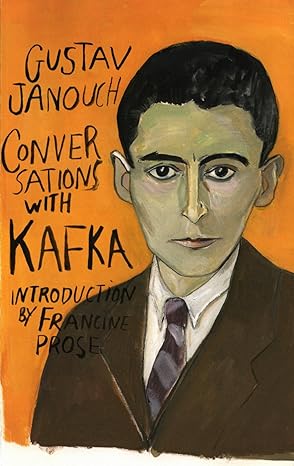
It was only later, when I read Conversations with Kafka, that I finally understood why he had previously eluded me: I simply did not know the man behind the words.
What kind of man was Kafka?
He held a doctorate in law, yet he was also an ordinary clerk at the Workers’ Accident Insurance Institute. He was the “rebel” of his own description, and the “homeless stranger” penned by his close friend Max Brod. Kafka had no home of his own, for as he once said:
“At home? I live with my parents. That is all. Although I have a small room to call my own, it is not a home; it is merely a sanctuary that masks my inner unrest, only to trap me even deeper within it.”
And literary creation, for Kafka, was perhaps nothing more than a helpless means to resist the daylight, to resist the self:
“If it were not for these grim, sleepless nights, I would not write at all. Yet, it is precisely because of them that I am repeatedly reminded of my imprisonment in this dark solitude.”
The question then arises: once we understand what kind of person Kafka was, does it mean we can finally comprehend his works?
Not necessarily.
Take The Metamorphosis, for instance. It evokes in my mind the modern phenomenon of the hikikomori—the shut-in youth living off their parents—but this could hardly have been the author’s original intent. How much comparability can there truly be between our life experiences and Kafka’s? Does our existence even require Kafka? As Kafka himself remarked:
“We can, with relative ease, distill many books out of life, but we can distill no life out of books.”
Our inability to understand Kafka is much like “the daylight failing to comprehend the darkness of the night”. Yet, we find ourselves willing to return to him, to read him time and time again. Why? Because having come to know Kafka, we simply cannot find it in our hearts to abandon him, all alone, to that bleak, sunless, and despairing frozen sea of solitude.