

This book is a popular science work written by my doctoral advisor. Within its pages lies every piece of scientific knowledge you could possibly want to know about blood types. Even for me, some of the content felt incredibly fresh. Reading Sensei’s approachable and accessible tone, I couldn’t help but be transported back to those days when he would personally carve out extra time just to walk us international students through the fundamentals of carbohydrate chemistry.
Category: 科学
-
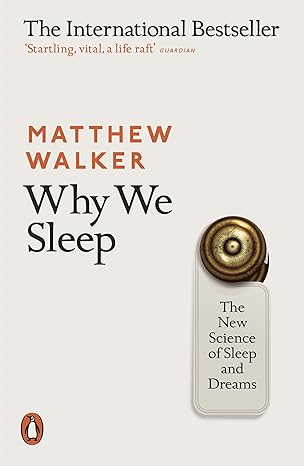
Why We Sleep: The New Science of Sleep and Dreams
I used to be a quintessential night owl. However, after making a conscious effort to change my routine, I gradually grew accustomed to a life without late nights.
Modern society tends to label night owls as “lazy.” After all, while others have already begun their study or work, you are still fast asleep. You might disagree with this “discriminatory” view, but consider this: how many “successful people” around you proudly claim that their success is due to sleeping until noon every day?
I don’t believe night owls are inherently lazy. To some extent, our sleep habits are dictated by our genes. Looking back at the era of our hunter-gatherer ancestors, someone had to stay awake deep into the night to stand guard and ensure the tribe’s safety. However, if you use this as an excuse to give up on improving your lifestyle, then I would indeed call you “lazy.” Laziness is not defined by your genes, but by your attitude. Furthermore, evidence shows that with practice, even a night owl can adjust and become an early bird.
That being said, please do not misunderstand the book I am introducing. This is not a guide on how to stop being a night owl. It is a scientific work about the essence of sleep, its functions, and how to sleep healthily.
My greatest takeaway after reading this book is the realization of just how vital sleep is to our health. As the author emphasizes: among the three pillars of health—sleep, diet, and exercise—sleep is the fundamental foundation. This book helped me cultivate a new habit, or more accurately, a conscious mindset: I must sleep well. -
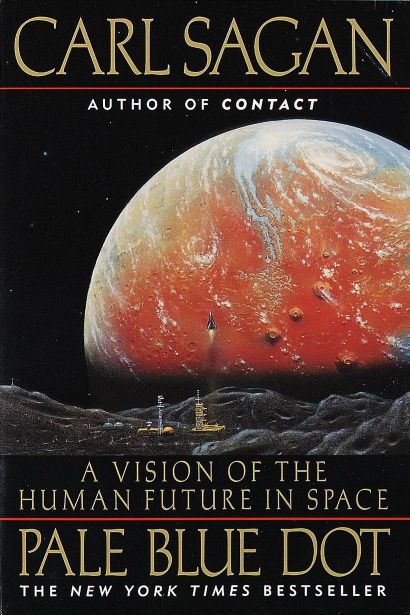
Pale Blue Dot: A Vision of the Human Future in Space
On Immanuel Kant’s epitaph, there is a famous passage from his Critique of Practical Reason: “Two things fill the mind with ever-new and increasing admiration and awe, the more often and steadily we reflect upon them: the starry heavens above me and the moral law within me.”
Indeed, astronomers lead our gaze toward the external universe, while philosophers turn our eyes toward the inner self. But Carl Sagan is different; he allows us to see both at once.
Personally, I find Pale Blue Dot even more compelling than Cosmos. Its layers are richer—it offers a rational scrutiny of human history, profound philosophical inquiry, and lucid scientific explanations of astronomical discoveries. Beyond that, it approaches the social issues of our reality with a deeply humanistic heart, envisioning the future of our species.
Faced with the starry heavens, Kant was filled with admiration and awe. Sagan, however, wrote: “It has been said that astronomy is a humbling and character-building experience.” For me, whenever I pick up a book on astronomy and use the magic of words to journey into the cosmos—looking back from that cosmic perspective at my own existence, infinitely small and fleeting on that pale blue dot—I feel an immediate sense of liberation. In that moment, the petty struggles and trivialities of daily life simply melt away. -
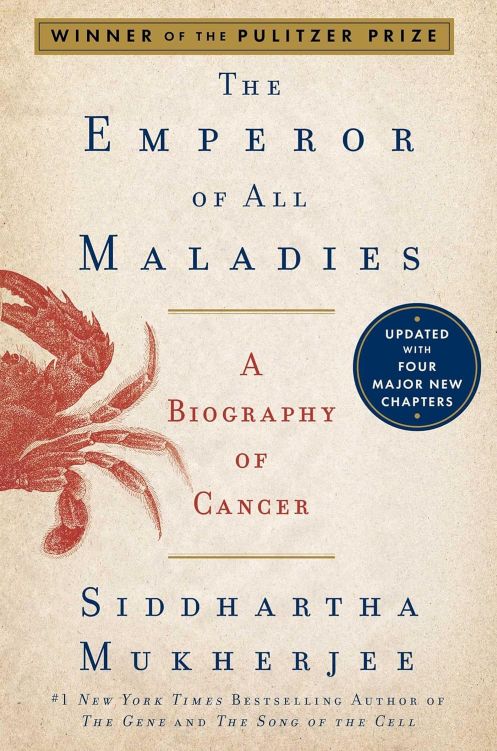
The Emperor of All Maladies: A Biography of Cancer
Siddhartha Mukherjee is my favorite popular science writer. He possesses a rare mastery of storytelling and professional expertise, all while infusing his prose with profound emotion. Few authors can balance these three elements in a single work, let alone execute each at a world-class level and weave them seamlessly into one cohesive theme.
This book is a history of humanity’s war against cancer, but it is equally a history of the progress of science and technology.
Cancer has haunted humanity since time immemorial. Ancient people understood it only through its surface symptoms: the Ancient Greeks called it a hard, domineering crab burrowed within us; the Ancient Chinese described it as something as unyielding as rock. Modern medicine tells us a different story: cancer is a rebellious program lurking within our genes, waiting to be activated to replicate, plunder, destroy, and expand. To describe it in philosophical terms: cancer is a dark version of the “self.” It is a self that craves immortality, wielding “dark magic” in a frantic attempt to break free from the destiny of decay and death. Yet, once this manic power becomes the master of our being, it consumes the fragile, original self without hesitation—only to inevitably march toward its own extinction in that very madness.
My doctoral thesis focused on cancer vaccine research, so reading this book often felt like hearing the echoes of knowledge and emotion resonating through my memories. On this road to defeating cancer, where have we been? Where are we now? How far are we from the finish line? The great pioneers have walked this path; they grew weary and eventually stopped. Thus, you and I have taken up the baton to continue the journey. One day, we too will grow weary and stop. But what does it matter? Our successors will follow in our footsteps, one after another, and they will go further than we ever could.
One characteristic of Mukherjee’s writing is that you don’t need profound professional knowledge to experience the joy of reading. His work can even stir your memories, bringing back bits and pieces of what you once learned in a classroom. If this book piques your interest, I would also highly recommend the author’s other two masterpieces: The Gene and The Song of the Cell.