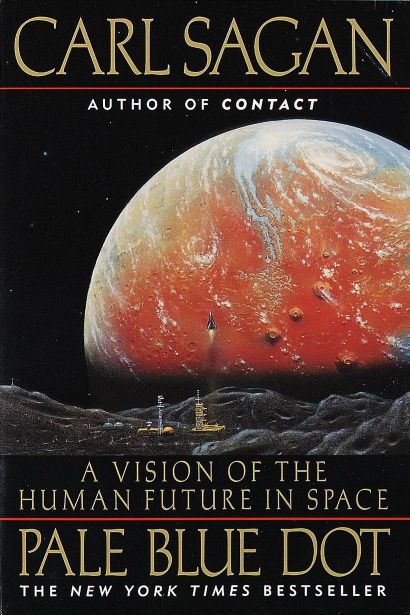
On Immanuel Kant’s epitaph, there is a famous passage from his Critique of Practical Reason: “Two things fill the mind with ever-new and increasing admiration and awe, the more often and steadily we reflect upon them: the starry heavens above me and the moral law within me.”
Indeed, astronomers lead our gaze toward the external universe, while philosophers turn our eyes toward the inner self. But Carl Sagan is different; he allows us to see both at once.
Personally, I find Pale Blue Dot even more compelling than Cosmos. Its layers are richer—it offers a rational scrutiny of human history, profound philosophical inquiry, and lucid scientific explanations of astronomical discoveries. Beyond that, it approaches the social issues of our reality with a deeply humanistic heart, envisioning the future of our species.
Faced with the starry heavens, Kant was filled with admiration and awe. Sagan, however, wrote: “It has been said that astronomy is a humbling and character-building experience.” For me, whenever I pick up a book on astronomy and use the magic of words to journey into the cosmos—looking back from that cosmic perspective at my own existence, infinitely small and fleeting on that pale blue dot—I feel an immediate sense of liberation. In that moment, the petty struggles and trivialities of daily life simply melt away.