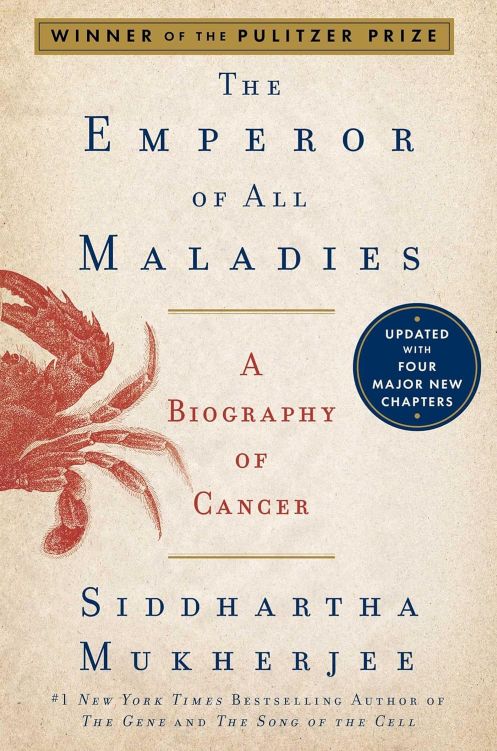
Siddhartha Mukherjee is my favorite popular science writer. He possesses a rare mastery of storytelling and professional expertise, all while infusing his prose with profound emotion. Few authors can balance these three elements in a single work, let alone execute each at a world-class level and weave them seamlessly into one cohesive theme.
This book is a history of humanity’s war against cancer, but it is equally a history of the progress of science and technology.
Cancer has haunted humanity since time immemorial. Ancient people understood it only through its surface symptoms: the Ancient Greeks called it a hard, domineering crab burrowed within us; the Ancient Chinese described it as something as unyielding as rock. Modern medicine tells us a different story: cancer is a rebellious program lurking within our genes, waiting to be activated to replicate, plunder, destroy, and expand. To describe it in philosophical terms: cancer is a dark version of the “self.” It is a self that craves immortality, wielding “dark magic” in a frantic attempt to break free from the destiny of decay and death. Yet, once this manic power becomes the master of our being, it consumes the fragile, original self without hesitation—only to inevitably march toward its own extinction in that very madness.
My doctoral thesis focused on cancer vaccine research, so reading this book often felt like hearing the echoes of knowledge and emotion resonating through my memories. On this road to defeating cancer, where have we been? Where are we now? How far are we from the finish line? The great pioneers have walked this path; they grew weary and eventually stopped. Thus, you and I have taken up the baton to continue the journey. One day, we too will grow weary and stop. But what does it matter? Our successors will follow in our footsteps, one after another, and they will go further than we ever could.
One characteristic of Mukherjee’s writing is that you don’t need profound professional knowledge to experience the joy of reading. His work can even stir your memories, bringing back bits and pieces of what you once learned in a classroom. If this book piques your interest, I would also highly recommend the author’s other two masterpieces: The Gene and The Song of the Cell.