It is strange to think that I never formally studied “economics” in a classroom. If any economic knowledge remains from my schooling, it is likely just a few fragments of Marx’s “theory of surplus value”. Yet, as members of society, while we might loudly proclaim our indifference toward philosophy, history, or politics—or return every math, physics and chemistry formula to our teachers—we can never claim that “the economy” has nothing to do with us.
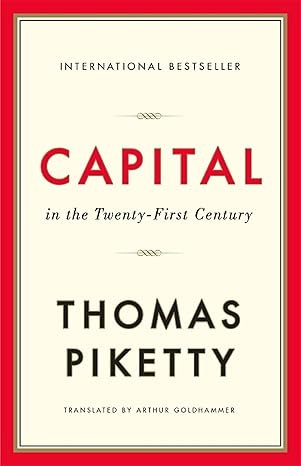
There is a popular business and finance channel on YouTube called “Xiao Lin Shuo”, boasting millions of subscribers, of which I am a loyal viewer. I remember in an early episode about book recommendations, she suggested highly narrative works like When Genius Failed, Too Big to Fail, and Freakonomics. However, she left a void when it came to books on macroeconomics. If I were to fill that void, my first choice would be Capital in the Twenty-First Century.
Allow me to briefly share why I admire this book.
First, it is an immensely ambitious work. I have read many “ambitious” books, but most of them either indulge in vague generalities, mistake a part for the whole, or suffer from loose structures and unclear themes. Capital in the Twenty-First Century is a clear exception. Its theme is the historical evolution and consequences of the wealth gap (or inequality in wealth distribution), and its ambition spans the entire globe. Speaking of ambition, Napoleon’s dream of conquering the world with cavalry and cannons failed, but Thomas Piketty has succeeded in laying bare the truths of this world through a single book.
Secondly, this book does not just tell us how the world is; it seeks to uncover the deep-seated reasons why it is this way. This involves a wealth of economic concepts and analytical research, which admittedly makes it a challenging read. Even economics students find it difficult, let alone a novice like me with no formal background in the subject. But dear reader, do not let the word “difficult” deter you; the parts we can understand are already enough to provide profound enlightenment.
Lastly, if we agree that the wealth gap is a problem that must be solved, we require a prescription—and Piketty is bold enough to offer one. This is perhaps the most widely debated section of the book. In my view, of all academic disciplines, economics is the one most prone to disagreement. I am well aware that macroeconomic issues cannot be settled overnight or with a single masterstroke. However, I admire the author’s spirit of “tossing out a brick to attract jade”—inviting further discussion. Progress in thought and institution can only occur when everyone joins the debate, can it not?