
We are left sad and sorrowful in the dark, until the stars light up and remind us that there is always something beyond.
—— Winston Churchill, The River War
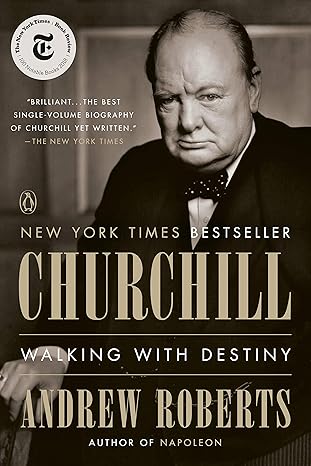
For the longest time, my understanding of Churchill was limited to a few lines in history textbooks; of the man himself, I knew next to nothing. Noticing how many people were reading about him, I picked up this masterpiece out of curiosity—and found myself utterly enthralled, unable to put it down.
Who exactly was Winston Churchill? In the epilogue, the author uses some thirty-odd nouns to define his identity. Allow me to follow suit and “teach a fish how to swim” by selecting a few of my own.
First, Churchill was a genuine aristocrat. Throughout his life, he required attendants for his daily routines; his noble upbringing meant he lacked even the most basic survival skills, like cooking a meal. Yet, simultaneously, he was a servant—dedicating his entire life to his country and laboring tirelessly for his people.
In times of war, Churchill was the ultimate Binder-in-Chief. He personally toiled to lash together allies being battered in the East with those reluctant to be battered in the West. This role turned him into a prolific traveler. As the book notes:
During his 1,900 days as Prime Minister and Minister of Defence, he traveled 110,000 miles by ship, train, and plane. He visited Cairo four times; Washington and Moscow three times each; Quebec twice; plus Bermuda, Tehran, Casablanca, Italy, Normandy, Paris, Malta, Yalta, Athens, Belgium, and Berlin.
Churchill was an extraordinary writer and orator. The Nobel Prize in Literature remains his crowning glory, awarded “for his mastery of historical and biographical description as well as for brilliant oratory in defending exalted human values”. He was also a natural wit. For instance, upon arriving in newly liberated Paris, he warned his audience before beginning his speech:
“I must warn you; be careful, for I intend—or rather, I shall try—to speak in French. This is a formidable task that will surely test your friendship for Great Britain.”
Finally, Churchill was an unabashed crybaby. Perhaps thanks to this emotional release, despite his excessive drinking, he lived to the ripe old age of 90, becoming a symbol of longevity. He outlived so many familiar faces: his King, his colleagues, his allies. In his twilight years, he became a political mascot and a living legend—an idol chased by rising stars.
Churchill’s life is the perfect embodiment of the word “Greatness”. To have lived a life as full as his is, beyond any doubt, a life well-spent.