
In 2024, with NVIDIA being one of the most valuable companies in the world and Jensen a billionaire many times over, readers might think I was trying to “climb high” back in 2013. In truth, at the end of 2013, NVIDIA’s market cap was only $9 billion—one-tenth of TSMC’s $90 billion. Jensen’s wealth back then was merely a single-digit percentage of that. I wasn’t “climbing”. Jensen’s answer to me was simply honest: he “already had a job”. His job was to elevate NVIDIA to the heights it has reached today, eleven years later.
— Morris Chang, Autobiography of Morris Chang: Volume II (1964–2018)
For a long time, my perception of NVIDIA was merely that of a company selling gaming graphics cards. Today, however, the countless entities of this planet have formed a massive fleet, setting sail to explore the mysterious and infinitely promising vastness of Artificial Intelligence. The flagship leading this fleet, and the commander at its helm, are none other than NVIDIA and Jensen Huang.
Morris Chang, former CEO of TSMC, shared a poignant anecdote in his autobiography: when he was considering retirement, he thought of asking his long-time friend of over a decade, Jensen Huang, to be his successor. Yet, to the olive branches Chang extended on two separate occasions, Jensen gave a simple, consistent reply: “I already have a job.”
Did Jensen foresee NVIDIA’s current monumental success back then? Some might argue that NVIDIA’s current status is purely a stroke of luck. But as Jensen himself puts it, NVIDIA’s success is “luck based on vision”. And that vision is rooted in nothing more than his unwavering passion for the “job” he has held for over thirty years, from NVIDIA’s inception to the present day.
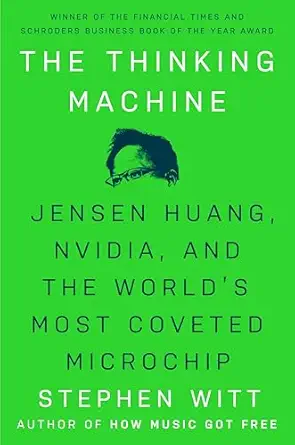
This book is not merely a biography exploring Jensen Huang’s family background and personal journey; it is equally a compelling journalistic account of NVIDIA’s evolution and the broader development of the graphics card and AI industries. Furthermore, the author does not shy away from documenting the “conflicts” between himself and the protagonist. This is precisely where the joy of reading in-depth reporting lies—depth often manifests in the passionate collision of differing values.