
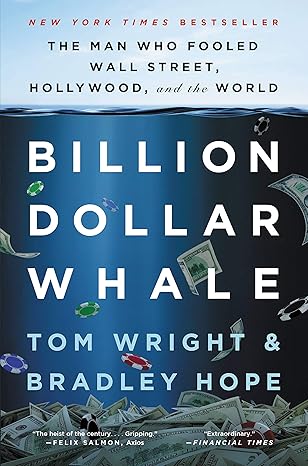
Many channels have covered Jho Low and his story from various angles, but none can match the power and depth of this book. A truly spectacular piece of documentary.
Category: 纪实
-

When the Heavens Went on Sale: The Misfits and Geniuses Racing to Put Space Within Reach
This book chronicles the figures and stories behind four space companies. As humanity begins to extend commerce into the cosmos, it reveals the countless triumphs and failures that have shaped this journey.
-
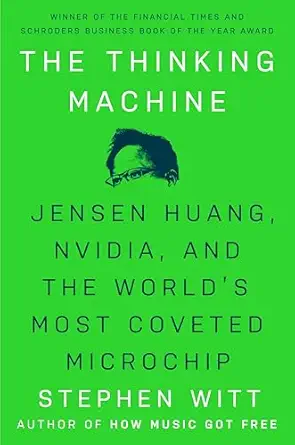
The Thinking Machine: Jensen Huang, Nvidia, and the World’s Most Coveted Microchip
In 2024, with NVIDIA being one of the most valuable companies in the world and Jensen a billionaire many times over, readers might think I was trying to “climb high” back in 2013. In truth, at the end of 2013, NVIDIA’s market cap was only $9 billion—one-tenth of TSMC’s $90 billion. Jensen’s wealth back then was merely a single-digit percentage of that. I wasn’t “climbing”. Jensen’s answer to me was simply honest: he “already had a job”. His job was to elevate NVIDIA to the heights it has reached today, eleven years later.
— Morris Chang, Autobiography of Morris Chang: Volume II (1964–2018)
For a long time, my perception of NVIDIA was merely that of a company selling gaming graphics cards. Today, however, the countless entities of this planet have formed a massive fleet, setting sail to explore the mysterious and infinitely promising vastness of Artificial Intelligence. The flagship leading this fleet, and the commander at its helm, are none other than NVIDIA and Jensen Huang.
Morris Chang, former CEO of TSMC, shared a poignant anecdote in his autobiography: when he was considering retirement, he thought of asking his long-time friend of over a decade, Jensen Huang, to be his successor. Yet, to the olive branches Chang extended on two separate occasions, Jensen gave a simple, consistent reply: “I already have a job.”
Did Jensen foresee NVIDIA’s current monumental success back then? Some might argue that NVIDIA’s current status is purely a stroke of luck. But as Jensen himself puts it, NVIDIA’s success is “luck based on vision”. And that vision is rooted in nothing more than his unwavering passion for the “job” he has held for over thirty years, from NVIDIA’s inception to the present day.
This book is not merely a biography exploring Jensen Huang’s family background and personal journey; it is equally a compelling journalistic account of NVIDIA’s evolution and the broader development of the graphics card and AI industries. Furthermore, the author does not shy away from documenting the “conflicts” between himself and the protagonist. This is precisely where the joy of reading in-depth reporting lies—depth often manifests in the passionate collision of differing values. -
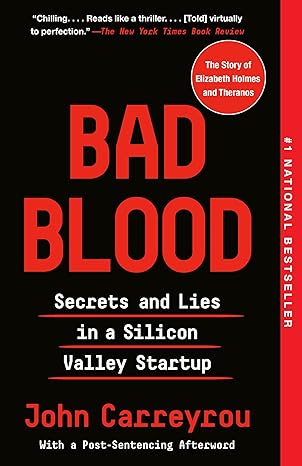
Bad Blood: Secrets and Lies in a Silicon Valley Startup
When it comes to physical exams, some might wonder: why do we need to draw two or three vials of blood? Isn’t one enough?
The reason is that blood tests analyze dozens of different components—such as various blood cell counts or concentrations of specific proteins that serve as health indicators. To detect these diverse elements, samples must undergo different pre-treatments before being sent to specialized instruments.
But what if a company claimed to have developed a device that could run hundreds of tests using just a single drop of blood? What would your first reaction be?
For modern people who believe in the boundless possibilities of technological innovation, this hardly sounds like a fairy tale. In fact, one company claimed to have achieved exactly that. This is the story of Theranos and its founder, Elizabeth Holmes.
Theranos was ultimately exposed as an unmitigated fraud, and Holmes could not escape her fate behind bars. But how did she manage to pull the wool over everyone’s eyes for so many years—deceiving employees, investors, regulators, and finally, consumers? In my view, the primary reason was “self-deception”. Holmes fell for her own lie. As noted in A Philosophy of Lying, quoting Nietzsche:
All great deceivers owe their power to a remarkable trait: in the actual act of deception, amidst all the preparations—the seductive voice, the calculated expressions and gestures—the true pivot is that the deceiver ‘believes in themselves’. It is this conviction that allows them to speak with such eloquence that everyone around them is swept into belief.
As a professional in the medical device industry, another fascinating aspect of this book is how Theranos bypassed the FDA—the world’s most stringent medical regulatory body. Simply put, Theranos wasn’t selling medical hardware subject to FDA clearance; instead, they offered “Laboratory Developed Tests”, a service historically less constrained by federal regulations. This case vividly illustrates why the FDA has been so determined in recent years to reform and tighten the oversight of clinical laboratory testing.
As time passes, Theranos has faded like drifting smoke. Yet today, we see the emergence of a novel (and compliant) medical model in the U.S.: consumers can collect blood samples at home using micro-collection tubes and mail them to accredited labs. Medical experts then provide online consultations and prescriptions based on the results, and medications are delivered directly to the doorstep. Perhaps one day, the vision of “testing with a single drop” will finally be realized. Under the banner of true scientific innovation, “impossible is nothing”.