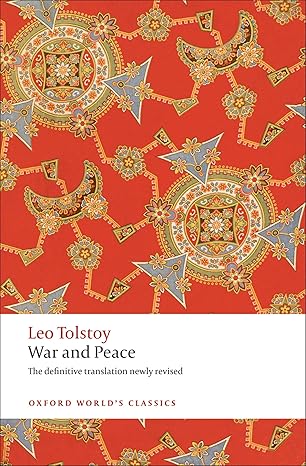
In my student days, almost everything I read was fiction. I remember a senior in my research lab once telling me: “You should read more non-fiction; novels aren’t that meaningful.” At the time, I couldn’t grasp the weight of those words. It wasn’t until I left the ivory tower and entered society that I began to agree. I became more interested in the actual world I inhabited—craving to understand the stories that had happened, were happening, and would emerge within it. Fiction seemed to belong to another dimension entirely. Gradually, my passion for novels waned; I even began to look down on them slightly, viewing them as one might view “junk food”—an occasional indulgence for relaxation.
That was, until I read War and Peace.
If I had to describe the sensation this book gave me in one word, it would be “Impact.” How can I even begin to convey the magnitude of that shock?
War and Peace is an epic. Its grandeur lies not only in the restoration of sweeping battlefields but in the vivid portrayal of countless characters. One cannot help but be submerged in the vast ocean of the author’s imagination. Tolstoy is a master of realism. He creates such an immersive experience that you feel as though you are standing right beside the characters—clearly seeing their expressions, hearing their inner monologues, and feeling their joys, angers, and fears. His prose is a form of art. Consider this passage, where the imagery is almost palpable:
Since Rostov had entered, her face had suddenly changed. It was like a multi-sided, carved, and painted lantern; originally appearing coarse, dim, and crude, but once lit from within, this complex and exquisite work of art suddenly reveals its startling beauty with unexpected clarity. This was how Princess Marya’s face was suddenly transformed.
Interwoven throughout War and Peace are profound explorations of history and philosophy. “The will of a historical hero not only fails to guide the actions of the masses but is, in fact, constantly being guided by them,” Tolstoy wrote. Regarding freedom, death, religion, and love—themes that permeate the novel—one moment I am stunned to find my own thoughts mirrored in Pierre’s mind; the next, I see the same phantoms I once glimpsed through the eyes of Prince Andrei. As a reader, I found myself constantly forced to pause, to think, to attempt to understand and resolve these questions—because they are, after all, my own questions.
There are books that, once closed, leave us different from who we were when we first opened them. For me, War and Peace is exactly such a book. It has fundamentally redefined the place of the “novel” in my heart.