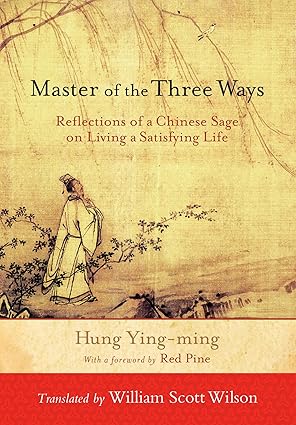
When it comes to classical works on the art of living, many naturally think of Marcus Aurelius’s Meditations. However, if I were to choose a representative from the East, it would be Caigentan (The Roots of Wisdom).
Ancient China was home to numerous philosophical schools, often summarized as the “Three Religions and Nine Streams”. The “Three Religions”—Confucianism, Taoism, and Buddhism—each have their own scriptures and tenets. Yet, Caigentan manages to weave the essence of all three into a single fabric, making it a truly extraordinary book.
The core of Confucianism lies in the emphasis on family, education, and ritual—values that continue to deeply influence the social fabric of China and its neighbors today. Furthermore, it teaches the “Zhongyong” (Doctrine of the Mean). What is the Mean? The following passage from the book captures it perfectly, perhaps revealing the root of the reserved, introspective, and humble character of the Eastern people:
In worldly affairs, one should neither drift with the current nor stubbornly defy it. In action, one should neither seek to annoy others nor strive solely to please them.
The essence of Taoism can be distilled into two concepts: “Wu Wei” (Non-action) and “Ziran” (Spontaneity/Nature). In the modern world, a state governed entirely by Wu Wei is hard to find. However, individuals pursuing a life of simplicity, detachment from desire, and harmony with nature are everywhere. As the book suggests:
One does not need grand achievements to be noble; to cast off worldly vanities is to enter the ranks of the elite. One does not need extraordinary scholarly effort to reach a sage-like state; to eliminate the obsession with material things is to transcend the ordinary.
Buddhism is a philosophy of “transcendence”. While I am considering elaborating further on the relationship between the secular and the transcendent more deeply in Oriental Philosophy, let us pause here to savor the poetic imagery of this verse:
A solitary cloud drifts out of the mountain valley, unattached whether it stays or goes; a bright mirror hangs in the void, undisturbed by either silence or clamor.
Lastly, I must mention that reading classical Chinese without annotations is, for me, like “looking at flowers through a fog”. Therefore, I deeply appreciate Professor Huo Mingkun’s edition. Not only is the modern translation brilliant, but the commentary accompanying each entry is truly insightful. For younger readers or those seeking a moment of peace in a busy day, the comic adaptations by Tsai Chih-chung are also an excellent choice.