In the memories of my childhood, there are two distinct fragments concerning Japan.
In my maternal grandfather’s room, there was a large bookcase filled with Chinese and foreign literary classics. Hanging on the glass door of that bookcase was a broad piece of red cloth, upon which were written several large, bold characters in brush calligraphy: “Sino-Japanese Friendship”. At that young age, I was entirely oblivious to the profound weight of emotion carried by those four words.
My aunt traveled to Japan in her youth to study, where she met a Japanese man who later became my uncle. When she first brought him back to China for a family gathering, I merely observed this Japanese man—who couldn’t speak a word of Chinese—with innocent curiosity. It wasn’t until many years later, when I stood by my aunt’s side in a Tokyo hospital to accompany my uncle through the final journey of his life, that I truly realized how kinship had long ago transcended national borders.
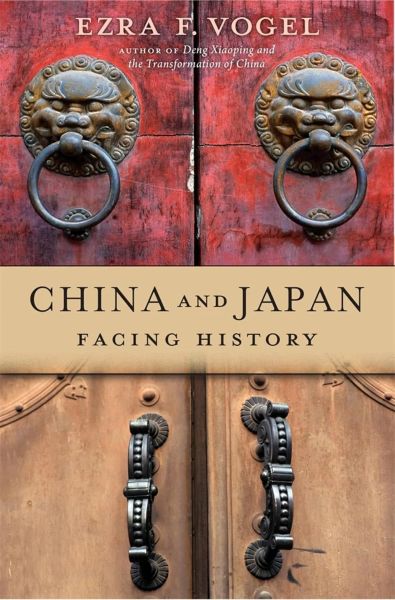
If I were to use one phrase to describe the relationship between China and Japan, it would be “a complex web of love, hate, and historical grievances”. This book is a work that focuses precisely on the ties between these two nations, specifically highlighting three historical periods of intense mutual learning: the Sui and Tang Dynasties, the late Qing and early Republic era, and the Reform and Opening-up period. For those who seek to understand these emotions without prior knowledge, or for those who know the history of only one side and wish to understand the other, this is undoubtedly the most objective and balanced recommendation. As Professor Ezra Vogel wrote in the book:
I understand that many Chinese or Japanese who dislike the other country will not be interested in a book about Sino-Japanese relations written by a Westerner; no matter how accurate it is, it might be in vain. However, this book is written for those in both countries who, like me, hope that China and Japan can understand each other. As an onlooker who has readers in both countries, I feel this is my responsibility.
The greatest gain I derived from this book was not a brand-new discovery of familiar history, but rather the “positive energy” and emotional warmth it conveyed. This was Professor Vogel’s final publication before his passing. After a lifetime of researching China and Japan, he placed his final emotional hopes on this work. I can only describe my feelings as “Kan-muryo” (overwhelmed with deep emotion).
In the translator’s preface of the Chinese edition, there is a thought-provoking passage:
A Western scholar once vividly summarized the recent friction between China and Japan with two phrases: “I’m sorry” and “Thank you”. China constantly accuses Japan of saying “I’m sorry” too rarely and without enough sincerity. Meanwhile, Japan feels that since the Reform and Opening-up, China has achieved its economic miracle largely due to massive Japanese economic aid, yet has never fully expressed gratitude or uttered a proper “Thank you”.
Actually, this sentiment could equally describe the relationship between South Korea and Japan. I once saw a popular Japanese politician state during a live broadcast that Korea should be more grateful to Japan because Japan brought “progress” during the colonial period. Yet, when I step among the people—in my own life—I have never seen individuals arguing until they are red in the face over national disputes. More often, what I experience are scenes of laughter, like Chinese and Japanese colleagues in my company singing The Flower of Woman together at a Karaoke bar.
Hermann Hesse once said: “I am happy to be a patriot, but first of all I am a ‘human’. If the two cannot be reconciled, I will always choose the ‘human’.” Both of my grandfathers were old revolutionaries and veteran Party members, yet I never heard a single word of hatred from them. Like Professor Vogel, their most simple and sincere sentiment was to cherish peace and long for a friendship that lasts forever.
Looking back at that red cloth from my childhood and the long arc of history, did our ancestors not also splash their ink across the scroll titled “A Narrow Ribbon of Water”? I hope our generation, and all the generations after us, can pass down the beautiful virtues of being a “human.” Perhaps that is the ultimate message this book intends to deliver to us.